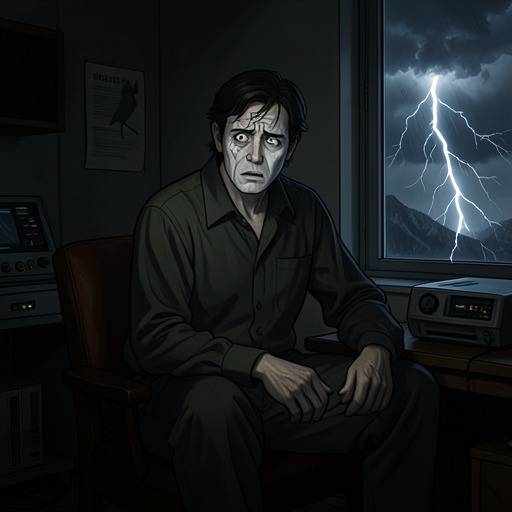
Silence
A cataclysmic lack of HarmonySilence is not merely the absence of sound in the book; it is a force that reorganizes relationships, labor, memory, and the sense of being alive. It appears after intimacy has collapsed, within repetitive domestic commands, at the limit of creative effort, and inside an SOS that may never be heard. Its decisive significance lies in this expansion: silence begins as interpersonal withdrawal and becomes a condition in which language, technology, and identity all risk failing together.
Silence as Abandonment
Silence first takes shape as the residue of separation. After the statement that someone has left, the text gives the condition a stark, isolated form: “Alone,” followed by “You left me,” and then “Silence.” The sequence turns silence into an immediate consequence of departure rather than a neutral pause. What remains is not peaceful solitude but the acoustic evidence of a relationship in which one speaker continues to address an absent other.
That failed address becomes explicit when the speaker imagines talking as though the other person were still present and asks why breath is being wasted. The question makes speech physically costly: words consume breath, yet no answer returns. Earlier, the pair “used to talk for days and days,” so the present silence is measured against an abundance of former conversation. Its force comes from contrast; communication has not always been impossible, but has deteriorated from sustained exchange into a void.
From Conversation to Fragmentation
The relationship’s decline is represented through reduction. The speakers once rode “the coaster of our youth,” described as reckless and unburdened, but the present leaves “nothing” except silent monosyllables. Even those fragments do not endure: they fade into the cold darkness of empty memories. Silence therefore operates both socially and temporally. It interrupts dialogue in the present and weakens the shared past until memory itself becomes vacant.
The same condition returns in the rhythm of repeated weather and time. “Day after day, rain after rain – then silence” presents silence as the final term in a cycle of recurrence. Rain supplies motion and duration, while silence stops the sequence. The speaker’s words are then described as worse than a thousand arrows, piercing a solitary but golden heart. Speech has not disappeared entirely, yet it no longer repairs the relation; after injury, words become another form of violence, making silence both the result of conflict and the atmosphere in which conflict persists.
Domestic and Social Command
Silence is also connected to a system that leaves little room for self-definition. In the passage on Gender norms, imperatives accumulate: washing dishes, preparing a meal, cleaning the room, vacuuming the floor, making the bed, and taking out the bin. These commands convert domestic life into an unending vocal schedule. Their repetition matters more than any individual task: the speaker is addressed as a function expected to maintain the household.
The imposed role is stated through the image of a vessel to be filled with crude oil. The person subjected to these demands is reduced to capacity and utility, while the surrounding expectations extend from work and consumption to marriage and children. The pressure culminates in the accusation, “You always disappoint me.” Silence in this context is not simply quietness; it is the space in which dissatisfaction, obligation, and inherited expectations continue to govern. The speaker sits on the floor with head between the hands while commands remain structurally louder than personal intention.
Silence, Memory, and Mental Escape
The text links silence to a life increasingly governed by solitude and the passage of time. A fragmented woman spends each day in solitude while the clock sentences her to a greater escape, carrying her through space and time toward an inevitable ultimate destination: Death. Here silence is adjacent to a condition of suspended living. The clock continues, but companionship and meaningful exchange have been stripped away, so time becomes a sentence rather than a measure.
The remembered intimacy of Childhood offers no simple refuge. The speaker recalls having to pretend, then running away from an entanglement of arms before losing the mind, and directly identifies silence as a killer whose favorite prey is the speaker. This gives silence an active, predatory character. It does not only conceal pain; it feeds on the inability to articulate or answer it. Memory returns not as a completed explanation but as a pressure that makes present speech urgent and unstable.
Failed Signals and the Edge of Existence
At the book’s technological and existential extreme, silence is translated into communication failure. The phrase “Failure - 404” frames absence as a system error, while repeated SOS calls ask whether the voice can be heard. The speaker’s sounds are inaudible, and the signal is repeated rather than answered. Repetition here resembles the earlier monosyllables and domestic commands: language continues to circulate, but circulation does not guarantee reception.
The consequence is a direct uncertainty about existence. The speaker asks, “Am I even alive?” as an emptiness takes over the house, followed by the possibility that this is “the end before the end.” Silence has therefore crossed from relationship and memory into ontology. It marks not only the loss of another person but the failure of any confirming response from the world. The book’s recurring silences finally expose a common structure: abandonment, social regulation, creative exhaustion, and emergency all become versions of an unanswered call.